
Your child might be eligible for disability support.
It’s not an easy process. It could take three years to get through all the systems. You’ll need some help filling out the paperwork.
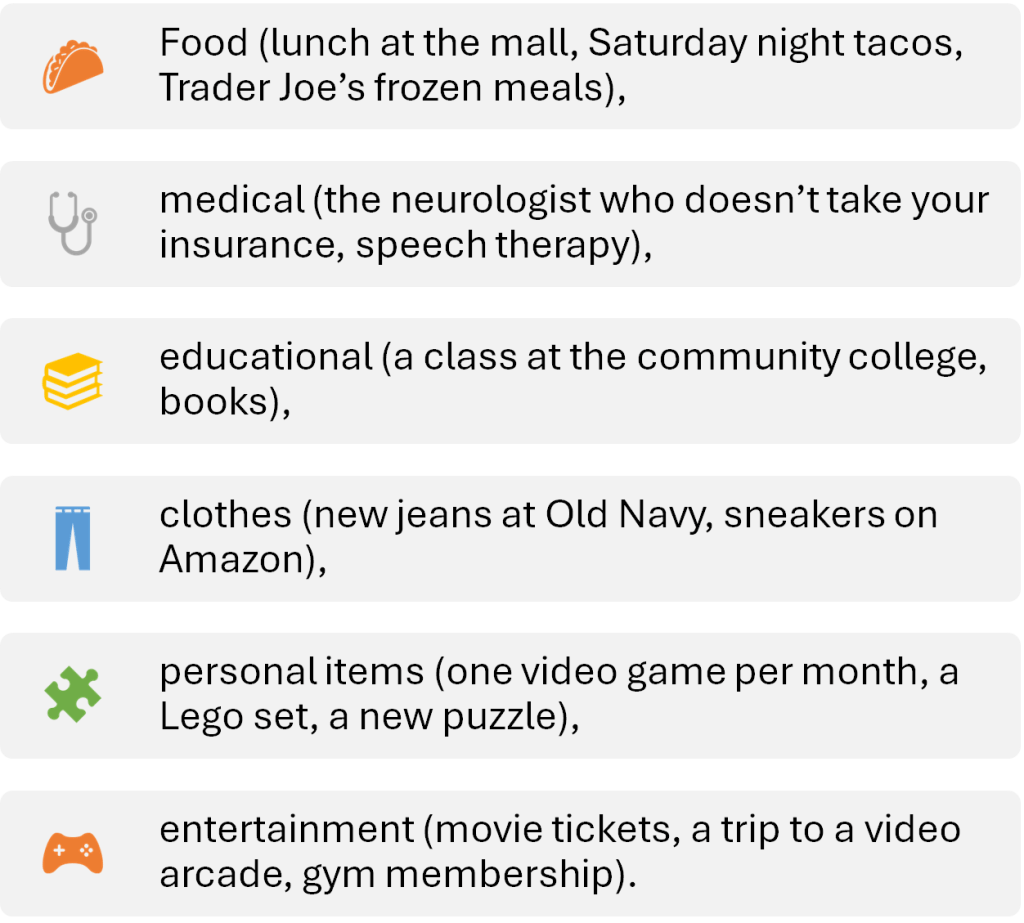
If your child qualifies, then the hard work will be worth it. Your child will receive monthly stipends that will cover items like food, clothing, your salary, college classes, and day programs. The programs will also provide instant support for your adult-child should you pass away.
We can give you an overview of the programs and support parents as they complete the forms.
SSI – Supplemental Security Income
Start the application process here — https://www.ssa.gov/apply/ssi
Supplemental Security Income (SSI) is a federal program that currently serves about 5.2 million beneficiaries. The application process could be a yearlong process. On average, monthly checks for about $650.
Requirements:
- For adults aged 18 years or older
- Have less than $2,000 in savings
- Have a documented disability that disability will interfere with Substantial Gainful Activity (SGA)
When should I begin to fill out the SSI paperwork?
You should apply for Supplemental Security Income (SSI) when your teen turns 18 and becomes an adult in the eyes of the government. While the forms can’t be submitted until their 18th birthday, preparation should start earlier.
Can my son qualify for SSI if I earn a good salary?
Because SSI is a program aimed at low-income individuals, the young person can never have more than $2,000 in their bank account. The government doesn’t care how much you earn, because this is a program for the young person, not you.
Tips:
- All bank accounts in their name should have 0.
- No mutual funds or stock accounts.
- Transfer funds at least three years before the application.
- 529 accounts are okay.
- Put savings in a separate account in your name, in an ABLE account, or a special needs trust.
- Consult your lawyer or financial expert for more tips.
What kinds of documented disabilities are eligible for SSI?
According to SSI, a documented disability is defined as “a medically determinable physical or mental impairment (including an emotional or learning problem) which:
- results in the inability to do any substantial gainful activity; and
- can be expected to result in death; or
- has lasted or can be expected to last for a continuous period of not less than 12 months.”
The government doesn’t have a checklist of official diagnoses that they recognize. Autism may or may not be covered, depending on its severity, so it’s very important to build a case that shows that multiple doctors think that their disability is significant and will impact employment.
- Get documentation from multiple doctors, other medical professionals, and schools.
- Get documentation for related disabilities, like OCD, anxiety, epilepsy, intellectual disorders, dyslexia, depression, and so on.
- Start asking for these evaluations at age 17.
- Evaluations should say, if possible, that the person cannot work at a typical full-time job and explain why.
What is Substantial Gainful Activity (SGA)?
The government says that a disability must be significant enough to prevent a person from earning “substantial gainful activity,” meaning that they could not earn $1,620 per month from any job.
What is Substantial Gainful Activity (SGA)?
The government says that a disability must be significant enough to prevent a person from earning “substantial gainful activity,” meaning that they cannot earn $1,620 per month from any job.
Since many people with autism have never had a job, parents should imagine their child working a part-time job at McDonald’s.
Ask yourself:
- Could my child make change?
- Could he stand on their feet for five to seven hours?
- Could he hear an order and click on the right buttons on the cash register?
- Could he work alongside other workers?
- Could he be polite to a rude boss?
- Could he focus on doing one thing for five hours?
- Could he concentrate on their job without a job coach?
- Could they handle a drunk customer?
- What would he do if a customer forgot their wallet?
- Could he not look at their phone for five hours?
- Could he avoid talking about their interests for five hours?
If fired from a job or internship, keep that information as evidence.
You don’t have to have an intellectual disability to receive these benefits. Poor attention, refusal to do low-interest activities, speech and communication issues, low muscle tone, repetitive actions or verbal tics, sensory issues – all issues that can interfere with SGA
How to Apply for Supplemental Security Income (SSI)
Applying for SSI is not a simple process. Roughly, there are three steps, which may take as long as a year to complete.
- The first step is to complete the initial application with basic information about addresses and phone numbers.
- Step two is a longer application that asks questions about your child’s functioning level.
- Step three is an in-person interview with a doctor or psychiatrist.
Tips:
- Be patient. They are understaffed. You’ll hand in paperwork and then not hear from them for a couple of months.
- Keep good records. Make copies of everything that you submit. Create a folder.
- Don’t give up.
- Do it at age 18. Don’t delay. Studies show that families that submit their applications at 18 have a greater chance of getting approval.
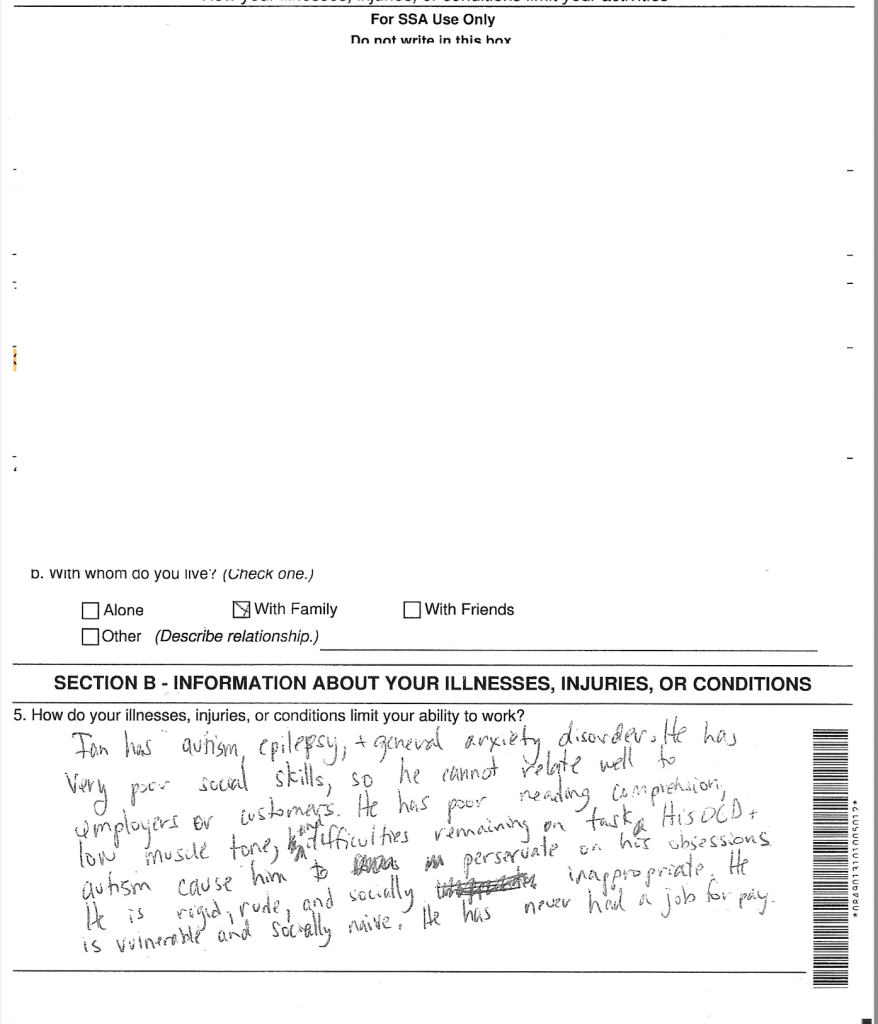
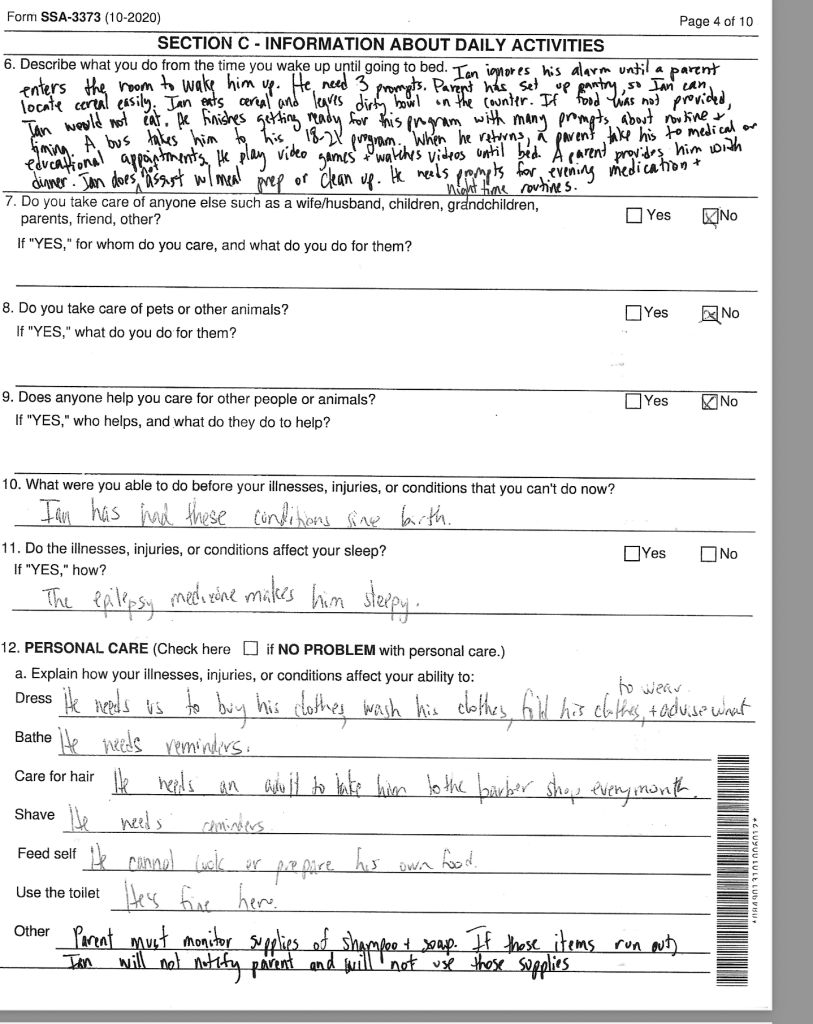
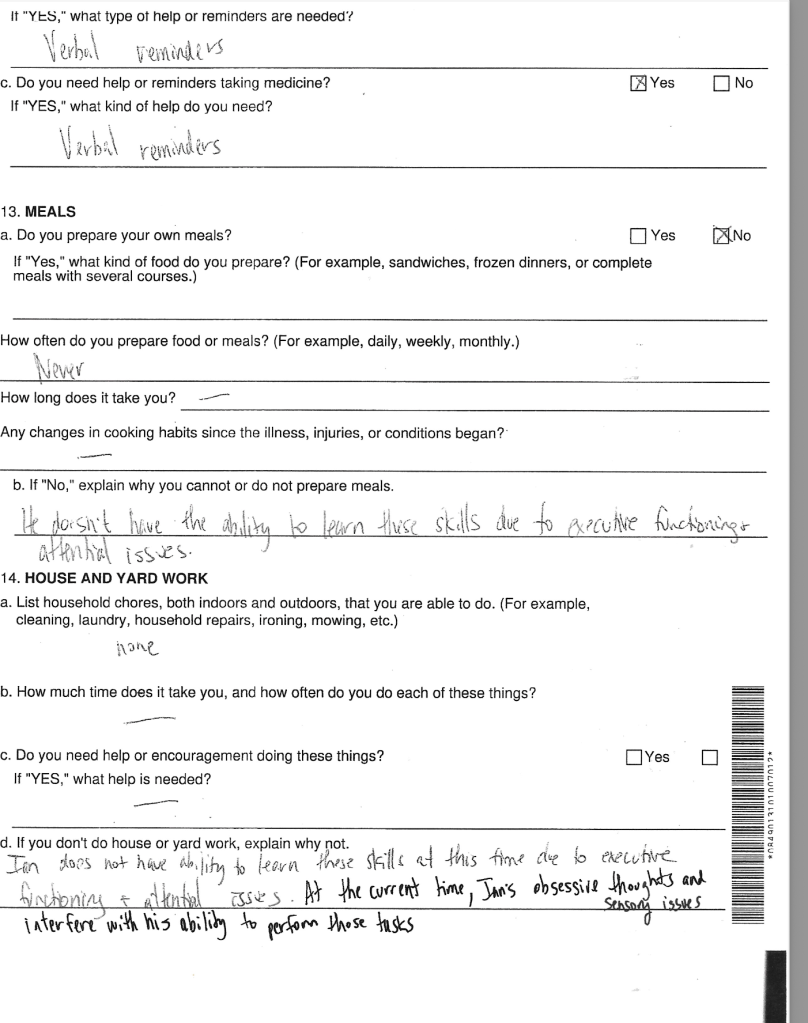
Step two of the application process is a long form that asks questions about your child’s disability. It is highly recommended that you get help from an experienced parent or social worker when filling out the form. You need to explain to the SSI administration that your child is highly disabled and is incapable of holding down a basic job.
Tips:
- Think about your child on their worst day
- Think about your child without your invisible support system
- Be very descriptive. Use up all the space.
- Do not lie
What does it mean to think about your child on their worst day?
Like everyone, our children have good days and bad. When asked to describe a day in your child’s life, write about their worst day.
Tips:
- Think about your children with no medication, no sleep, hangry, and stressed out.
- Recall a real-life bad day that you would prefer to forget.
How do I describe my child with no support?
As parents, we do a lot for our children. Sometimes, the support systems that we have set up for them to be successful are invisible and unconscious.
A question on the SSI application might be: “Can you eat breakfast on your own? Yes/No” (You will fill it out for your child.) You might think, “Yes, my son makes himself a bowl of Cheerios every morning.” You might want to check the “yes” box. However, you should first ask yourself a series of questions: Who buys the cereal? Do you set up the cereal on the same shelf every day? Who puts the bowl in the dishwasher? Who buys the milk? Is the milk in the same place in the fridge? Do you buy a particular brand of cereal every week? What happens if there isn’t any cereal on the shelf? Would he not eat that day?
Tips:
- If they have never done something, then the answer to the question is always no.
- Another thought exercise – think about your child alone in a hotel room for a week. Would they take a bath? Would they eat regular meals? Would they know where to go to buy toothpaste?
Sample Application
The SSI Interview
The SSI administrators will review your application. They will either decide to reject your application (and you’ll start the appeal process) or send you to a doctor or psychiatrist for an in-person interview.
A doctor will ask your child a series of questions. She might ask your child to repeat a set of numbers forward and backward. She could ask your child to explain what the term “raining cats and dogs” means.
The doctor may ask you about sensitive issues, like mental health challenges. Ask if you can discuss these issues with the child in the hallway. You don’t want to hurt your child’s feelings, and you need to talk freely with the doctor about all the problems.
It’s best if the examiner sees your child on his worst day, because one bad day at a job will get them fired. So, don’t give them their medication that morning and have them eat two jelly donuts before going in there, which are all possibilities in the real world. If your child is dysregulated and acting inappropriately, do not correct them or nudge them to behave. This is one time when you want them to be as disabled as possible.
There will be some questions that your student can’t answer because of language difficulties or because they’re uncomfortable with questions. You’ll have to speak up then. Unfortunately, you’ll have to speak negatively about your child in front of them. You might have to describe disturbing mental health issues and rehash some painful experiences. It will feel very mean to talk this way in front of your beloved child, but it is necessary. This evaluator must understand the full extent of your student’s disabilities before giving their approval for SSI.
Your student might feel depressed after the interview because they couldn’t answer questions, and you highlighted their weaknesses. It’s unfair that families must be put in this position, but this is how the process works. So, on the drive back home after the interview, explain to your child that they were interviewing for a special scholarship that goes to people who have overcome various obstacles. So, that’s why you had to bring up those problems from the past. But you are so proud of them for working so hard and doing such a great job. Then take them out for a burger and fries.
Tips:
- Before the meeting, give your child a sugary soda and skip their meds. This is them on their worst day. You want the medical examiner to see this.
- If they are struggling to answer a question, don’t help them.
- If their behaviors are poor, do not correct them.
- Afterwards, take your kid out for ice cream and give them lots of praise. It’s difficult.
SSI Appeals
The data shows slightly more than all SSI applications are rejected the first time around, with another 10 percent getting rewarded after an appeal. However, it is unclear of why so many applications are rejected. Many rejections may be due to incomplete applications.
By completing the forms as we suggest, you’ll increase your chances of a first-time acceptance.
To appeal, you should hire a lawyer. If they win your case, you will be entitled to retroactive funds from when you first applied for SSI. Their commission will be deducted from your settlement check. If they lose your case, they receive no funds, so lawyers might be picky about the cases they accept. You might have to shop around for the right lawyer.
SSI Payments
The average SSI payment is $678 per month, or $8,400 per year. If you fill out the paperwork to charge your child a rental agreement, get another $300 per month if you change your child rent.
- Put everything in one bank account in their name. Direct deposit.
- Bank statement records.
- A debit card for them.
- Keep an eye that the money doesn’t go past $2,000.
- At the end of the SSI process, a disabled adult will receive around $650 per month,. He’ll receive another $300or so per month, if he’s living alone or parents charge him rent. Funds will go directly to the individual, not the parents. In one year, that comes to $7,800.
- Set up a bank account in your child’s name, which can be accessed by you. The government will send the funds directly to the bank. Checks arrive bimonthly with no paperwork. The good news is that you’ll rarely need to interact with the Social Security Administration again. Yes, it was hell getting into the system, but once you’re in, everything just happens automatically unless funds exceed limits or the individual no longer needs help. Some parents have reported getting random check-in phone calls from staff. You’ll need to contact the office when your child starts earning money and/or after you retire, when you’ll switch to the SSDI system.
- Your young adult should get a debit card to spend their funds. A debit card will provide records of expenditures, which can be shared with the government in case of an audit. It’s also a useful way for your young adult to learn how to purchase small items for themselves around town and gain independence. It’s good for them to spend money in little ways without having to ask you for a hand-out.
- With your name on the account, you can monitor the account to make sure that your child hasn’t overdrawn the account and has spent enough. Your child can never have more than $2,000 in that account or in any bank account, while receiving SSI. If their savings exceed $2,000, your child could lose all their benefits.
- Can become a “representative payee” too. Advanced info. Not doing that tonight.
Appropriate Uses of SSI funds
Can also put extra money in an ABLE account
What’s Next?
Medicaid and the State System Comes Next. Coming soon!
Subscriber Content
Add content here that will only be visible to your subscribers.
 The Autism College Connection